When TV Becomes a Social Hub: Milan-Cortina 2026, Sanremo 2026, and the Role of Content Creators
For years, we treated TV and social media as two separate channels, with different timelines, languages, and metrics. In reality, for some time now—think of the second screen and social TV—television and social media platforms have been interacting: viewers watch live, comment, share, and reinterpret what they see, often from their smartphones. Today, however, this dynamic is no longer merely spontaneous and peripheral, because during major events it is planned and integrated into editorial and communication strategies.
In 2026, in Italy – with the the newly inaugurated Milan-Cortina Winter Olympics having just kicked off and Sanremo moved to late February to avoid overlapping with the Games—two perfect, current, and very different examples emerge that help us understand this evolution.
Milan–Cortina 2026, with a narrative that begins months in advance and spans regions, communities, brand partners, and creators; and Sanremo 2026, a television event that has long been a social phenomenon, enhanced by interactive game mechanics such as FantaSanremo, launched in 2020 and grown into a community ritual. The real question is no longer “TV or social media,” but how to design an event so that it can thrive across multiple touchpoints: traditional television, streaming, social media platforms, and brand-owned assets.
Table of Contents
From commercials to branded entertainment
The classic format was simple: program, commercial break, commercial, with advertising perceived as something that intrudes from the outside into the flow of entertainment. In premium events, however, the trajectory today increasingly resembles a journey in which the event, content, and branded entertainment are woven together through formats, experiences, and projects involving branded content and branded entertainment.
At this point, the natural question is: if content is the message, who produces and disseminates it? In recent years, even in Italy,influencer marketing has established itself as a structural lever: according to UPA 2023 estimates, investments in influencer marketing have reached approximately €323 million, with growth of around 10% compared to the previous year, and about 90% of member companies report using it. This does not necessarily imply a reduction in television investments, but often a reallocation of them: not just dominating the peak, but building value throughout the entire pre-, during-, and post-event journey.
Premium TV events as cross-media hubs
Premium events continue to offer something that no single social media platform can provide on its own: the ability to capture the attention of the masses at a specific moment, with strong symbolic and shared significance. Linear TV “validates” the event, makes it mainstream, and establishes its cultural importance, while social media expands the duration, language, and depth of the conversation surrounding what is happening live.
In practice, television creates the big live moment, while social media sets the stage, provides real-time commentary, and transforms it into content that can be replayed, remixed, and distributed over time. Creators serve as a bridge: they bring the event into community feeds, translate television’s language into native digital formats, and guide the audience across TV, streaming, and brand assets (website, app, e-commerce, CRM).
| Element | Linear TV | Social / Creator |
| Role in the funnel | Mass reach, shared live event | Engagement, conversation, active niche communities |
| Weather | A spike concentrated over just a few days | Always-on cycle: before, during, and after the event |
| Language | Programs, hosting, commercial breaks | Original formats, user-generated content, memes, remixes, recaps, serialized formats |
| Typical outputs | Live, highlights, official clips | Reactions, behind the scenes, POV, audio trends, challenges, segments |
| Measurement | Auditel/share, GRP (reach × frequency) | Views, engagement, share of voice, share of search, community growth |
A concrete example: in recent editions of the Sanremo Festival, the event has been broadcast live on Rai1, rebroadcast on RaiPlay with clips and highlights, and simultaneously covered by creators and communities through reactions, memes, and dedicated content on TikTok and Instagram. It’s worth noting that this approach didn’t emerge in 2026: in Italy, people have been talking about Social TV for at least a decade—a phenomenon tied to the use of social media (including X/Twitter) as a “second screen” to comment live on programs and shows, with official hashtags and community dynamics accompanying the viewing experience.
Case 1: Milan-Cortina 2026 (the event that takes shape months in advance)
Milan–Cortina 2026 is not just a sporting event: it is presented by industry insiders as a communication platform of enormous scope for institutions and sponsoring brands, where sponsorship goes beyond the simple “logo space” to become a long-term editorial and narrative project. The Olympic torch relay is one of the most obvious examples of this approach.
According to official reports, the Milan–Cortina 2026 Olympic torch relay traveled across Italy from December 6, 2025, to February 6, 2026, covering all 110 Italian provinces over a distance of approximately 12,000 km, with stops in dozens of cities and thousands of torchbearers, including celebrities and ordinary citizens. The journey concluded with the Games’ opening ceremony, transforming the relay into a widespread narrative that accompanied the country toward the start of the competitions.
This narrative machine also features creators and pop culture figures selected in collaboration with commercial partners and broadcasters: among the most talked-about moments are the stops featuring Snoop Dogg as a torchbearer in Gallarate, his viral curling clips, and his appearances at iconic locations like the Balera dell’Ortica, which quickly became global social media sensations . The meaning of the torch shifts, at least in part: from a predominantly sporting ritual to content that travels through feeds, generating memes, reactions, and transnational conversations.
For the organizing committee and sponsors, featuring creators and celebrities in prominent roles means:
- create engaging, personal content (stories, reels, vlogs, POV videos ) that appears on the profiles of creators, brands, and the Games’ official channels;
- expand the event’s reach to audiences who experience Milan–Cortina first through social media feeds and only later—if at all—on TV or via streaming, thereby boosting awareness and familiarity with the Olympic brand.
At the same time, major campaigns by partners —such as Coca-Cola’s integrated ecosystem with The Peak, featuring a national promotion, activities in the Villages, and a robust PR and social media strategy —demonstrate that live television is just one piece of a much broader narrative, designed to span cities, digital platforms, and experiential events.
Case 2: Sanremo 2026 (the festival as “second screen first”)
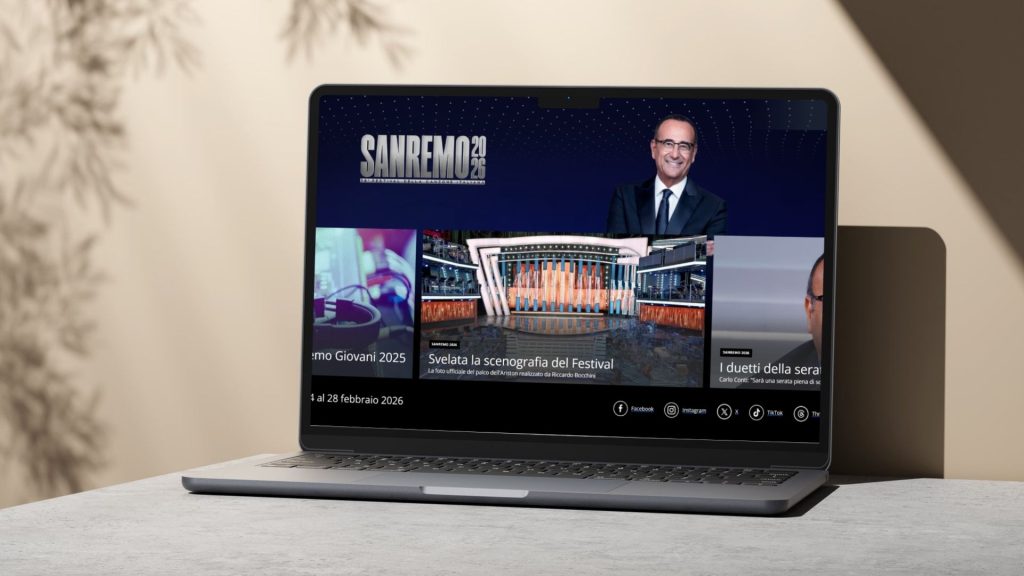
Sanremo is probably the clearest example in Italy of the convergence between TV and social media: it is a television program, but it is also—and increasingly so—a social and digital phenomenon. In 2026, this is even more evident: the festival takes place from February 24 to 28, following the conclusion of the Milan–Cortina Olympics, during a veritable “month of major events” curated by Rai to avoid overlap and maximize attention.
In the weeks leading up to the premiere, the anticipation turns into a digital pre-show. The Sanremo experience moves to social media feeds: the songs and artists in the competition are announced, the stage design is revealed, content from the headliners starts appearing on social media and in the press, while playlists like “Waiting for Sanremo 2026” set the stage by combining classic tracks with new releases from the competing artists.
In recent years, the digital conversation surrounding the Festival has become an integral part of the experience: memes, live reactions, recaps, editorial formats, branded content, user-generated content, and challenges. FantaSanremo, launched in 2020, has served as a cultural accelerator, transforming the festival into a collective game in which viewers actively participate, form teams, follow the performances according to their own rules, and fuel a parallel narrative.
The 2025–2026 analysis confirms that the second screen is no longer just a side dish: during Sanremo, viewing is systematically split between TV and smartphones, with peaks in social media interactions related to fashion, technology, performances, and viral moments. In short, Sanremo doesn’t end with the finale: it’s a content machine that builds anticipation, explodes in real time, and selects memorable moments afterward, transforming them into trends, audio clips, and lasting conversations on Instagram, TikTok, and other platforms.
Note for marketers: Why not stop at the commercial?
In terms of advertising spending, various analyses based on Rai Pubblicità’s rate cards indicate that a 15-second spot during prime time at the Sanremo Festival can cost in the hundreds of thousands of euros, while certain forms of TV promotion can exceed one million, depending on placement, format, and time of year. These are not fixed or universal figures (they are subject to negotiation and seasonal fluctuations), but they give an idea of the scale of investment required to secure a high-profile linear slot.
In this scenario, integration with creators, Social TV, and cross-media distribution is not a shortcut to “spending less, ” but a way to transform a very expensive medium into a content system that generates attention, recall, and engagement even outside of commercial breaks. Consequently, measurement cannot stop at ratings: in addition to TV ratings, social engagement, community growth, share of search, brand lift indicators, and signs of business impact become crucial.
Influencers as distributors of attention
If we look at the two cases from 2026 together, the pattern is clear: creators are not merely “guests,” but hubs for distributing attention. In practical terms, they bring the event into already engaged communities, translate television language into native social media formats, and connect different touchpoints—TV, streaming, social media platforms, and brand assets—into a single, cohesive experience.
For brands, this means a change in strategy:
- Premium events are not just opportunities to buy advertising space, but content hubs that need to be curated before, during, and after the event;
- Effective planning requires a well-designed ecosystem: broadcaster , official channels, talent/athletes/artists, creators, and brand assets (apps, website, CRM);
- KPIs must be integrated: in addition to TV ratings and reach, social engagement, community growth, search share, brand lift metrics, and—where possible—indicators of business impact are now crucial.
An interesting side effect, noted by several media professionals, is that when an event is truly “premium” and well-designed, it can become one of the few occasions when younger audiences return to enjoy a shared live experience—even if mediated by second screens and digital platforms. In this sense, social media and creators do not undermine TV, but can help keep it central to the media mix, shifting the competition from “where” to “how” the experience is designed.
The strategic question for 2026
So the question for 2026 isn’t “Which is better: TV or social media?” The real issue lies further upstream: when we plan an event, do creators come in after the creative process—as amplifiers of something already defined—or before, when we decide what the content should be and how it will play out across the stage, social feeds, and brand assets?
The examples we’ve been seeing in recent weeks—from the Olympic torch relay turned into viral content to the Milan–Cortina/Sanremo relay, conceived from the outset as a month-long cross-media experience—show that this approach is no longer just a theoretical concept: it’s what sets apart those who merely “show up” from those who succeed in transforming an event into a lasting content ecosystem.
For agencies, brands, and broadcasters, the answer to this question is not tactical: it is deeply strategic, because it determines how attention will be shaped in the coming years.
Are you planning an event or campaign related to Milan-Cortina 2026 or Sanremo?
Let’s talk: we can help you transform a media outlet into a content ecosystem that thrives before, during, and after the live broadcast, integrating TV, creators, and proprietary assets into a single, measurable strategy.